15 Sept 2012

Venturing South

Over two consecutive weekends I visited my friend Jude who is working in Lewes over the summer. I had never been to East Sussex before and I was very impressed by the sights I encountered.

First of all Lewes. It's a beautiful town with picturesque houses and graceful gardens. You can find the ruins of an old monastery with an extremely well developed toilet system so that no monk had to queue for the latrines (Yes, that's the detail I picked up on...). There are many independent cafés with organic and original food. The one we went to didn't even serve coke. A respectable town should always have a castle, which Lewes does have. Unfortunately we didn't have the time to visit it, but the view over the valley was also worth the steep walk up the hill.

We did a quick trip to Brighton, which is only 15 minutes from Lewes if you take the train. We arrived there a few hours after the world-famous gay pride parade ended. The atmosphere had gone from festive to rather drunk and merry, which was interesting... We walked up the Pier, tried a few arcade games, watched the scary-looking rides from the safe ground to finally sit down on the free deck chairs on the Pier. Before I had to embark on my long journey back to Essex, we also took the chance to wander Brighton's artsy streets. It is definitely a place I want to go back to so that I can explore more of it!

Brighton

The next Saturday was part of the heritage open days, which take place every year in September and that way we had the opportunity to visit Bodiam Castle for free. Built in the 14th century this edifice is 'what a castle should look like'(Jude) and that is the exact same observation I made. If I had to draw a castle I would draw something very similar. The castle is located in a beautiful valley and anachronistically a steam train suddenly choochooed past us, as we were having both lunch and a hysterical fight against the local wasp community.
Bodiam Castle

Our next brief stopover was Rye, which is an adorable little town, with cute tea houses, gorgeous shops and small cobbled passages. After visiting the local craft fair, we had to get a move on as the sun was setting.

The Grand Finale of the day was the view onto the Seven Sisters. These legendary cliffs are a beautiful background for pictures and we definitely took advantage of that with a mildly embarrassing photo shoot. However, I have to say that we were extremely lucky with the weather and a dim sunsetting light illuminated the landscape. Jude knew of a great shortcut towards the view, through a remote residential area of Seaford, which shortened the usually 25 minute walk from the town to about 5 until we saw the Seven Sisters. The view is worth a detour (and was definitely worth me being really late for my train and nearly missing it!).

Seven Sisters

For anyone who wants to see a beautiful part of England I would definitely recommend East Sussex, as you can just drive around and see gorgeous scenery, cute cottages and impressive country houses before you even get to the many sights that are just waiting to be visited by you!

2 Sept 2012

Essex Tales

In the past two weeks I've been exploring one of the most talked about counties in the UK. Beyond the general stereotype of the 'Essex girl' with which I had been confronted with when I first came to the UK, I decided to also watch the infamous TOWIE (The Only Way is Essex) as part of my 'research into the local culture'. In all fairness I got quite bored with it and it didn't teach me much... So rather I felt it to be my duty to write about my experience here, in case you also relied on these stereotypes.

Romford Market Place

 It's market day in Romford, there is a soft and constant drizzle and a man is sheltered under a roof, playing a gloomy melody on his trumpet, occasionally water splashes from the tarpaulin that covers the market stands. Romford being a historic Markettown, shopping is obviously the local sport. I surrendered and am quite thrilled to explore the various malls, which are definitely confusing for the foreign visitor. As I get out of the shopping centre, I hold on tight to my shopping bags, keeping my head down as it seems the rain just got heavier. I can't help but notice the footwear of the locals. Half of people, though mostly women, are wearing flipflops or Birkenstock. Some less crazy ones are wearing sandals... and here I am, wondering why anyone would look out of the window, see the grey sky and think that flipflops would be a good idea. But really, what I should admire is the people's immune systems. If my Mum saw me wear open shoes in such weather, she would run after me with a frying pan threatening me into changing into sensible trainers or boots, because I would otherwise catch pneumonia... and I'm rather inclined to believe her.

But I am being slightly unfair here, because I have actually really enjoyed my stay in Romford. I was lucky enough to find a home in Collier Row, a bit outside the city centre and rather near the countryside. The weather has been really nice ( it even went beyond 30°C -God bless swimming pools), much nicer than the climate I know from Birmingham. And also, green spaces are only a short walk away, the number of parks is just incredible. With my bike I explored the surroundings and quickly found myself in the middle of fields, literally surrounded only by fields. Here is a picture that in my opinion represents Essex well: two horses in the middle of field and in the distance you can see the London skyline. 


It's the countryside, half an hour away from the big smoke. And although I like London and its seemingly uncountable opportunities for entertainment, food; drink, culture and intellectual exchange, I realised when I was coming back from a day out there last week, that I really appreciated the peace and quiet in Essex. - Maybe I'm just getting old?


Havering-atte-Bower

18 Jul 2012

Hon(n)i soit qui mal y pense


As I am writing this I am somewhere between England and France. I am on my way back 'home', France anyway. This is the end of my time in England, for now. I can still remember arriving here, about 4 years ago, being really scared and feeling quite lonely at first. I didn't understand most of the people, they had all sorts of different strange rules - these were my first and unhappy encounters with health and safety regulations. But I got to know people, students from all over the world as contact with other foreigners was much easier at the beginning - making British friends took a bit more time, but I've got them now! Speaking with people became easier as well and Birmingham had suddenly become my home. Birmingham and I had our ups and downs, more downs during the extremely busy final year, even though the last two months I spent in England passed by in the blink of an eye.

In a very franco-british way, I believe that I have developed some kind of love-hate relationship to the country, which makes me hate the weather above all and complain about it constantly (I’m sorry!) but I could not stop the tears from rolling down my cheeks as the ferry left Portsmouth harbour.

Living in England is easy, you don't really feel foreign because there are so many different people of different origins, that I have never felt excluded. I mean I felt right where I was.


I have seen great places in Britain over the three years I have lived here. I will just mention a few which I haven't talked about in other posts. There are two places I'd like to recommend, these are York and Aberystwyth. I had never been told to visit York until a few months ago and I was intrigued, thinking that the only nice thing north of Birmingham was Scotland... how wrong I was. York was just so lovely with its little streets, its seemingly infinite amount of cute cafes, the different historic monuments and the walk along the city walls. It is a nice daytrip destination I believe, possibly in 'summer' :)

Aberystwyth is foremost a challenge for every foreigner when it comes to pronouncing its name. Luckily, I heard it many times in lecture, as we were informed by possibly every member of staff that international relations first emerged as a discipline in Aberystwyth in 1918. I then discovered that this oddly written place was in Wales and actually one of the nearest coastal places if you are in Birmingham! Off we went on a sunny but cold November day... to this beautiful and peaceful place. I admit there isn't much entertainment , but for a daytrip it was definitely worth it! The castle ruins, the walk up to the National Library of Wales and the promenade also offer many photo opportunities! Not to forget the panoramesque train journey from Birmingham!

Now, I just have a few concluding remarks to my time in England on various things that I saw, that I got annoyed at or that I laughed at. A few odd observations, that might make other people who have moved to the UK nod or smile, while making our British friends think about some of the peculiarities of their own country (if they haven't heard it from me before that is!)

Boots: Yes, I mean Boots, the store. I love it. And a lot of other people from abroad do. Why you might think, it's just Boots! Well, I think for us it's because it doesn't exist at home, no store has everything from medicine, other health products to beauty products... it just makes any woman happy!

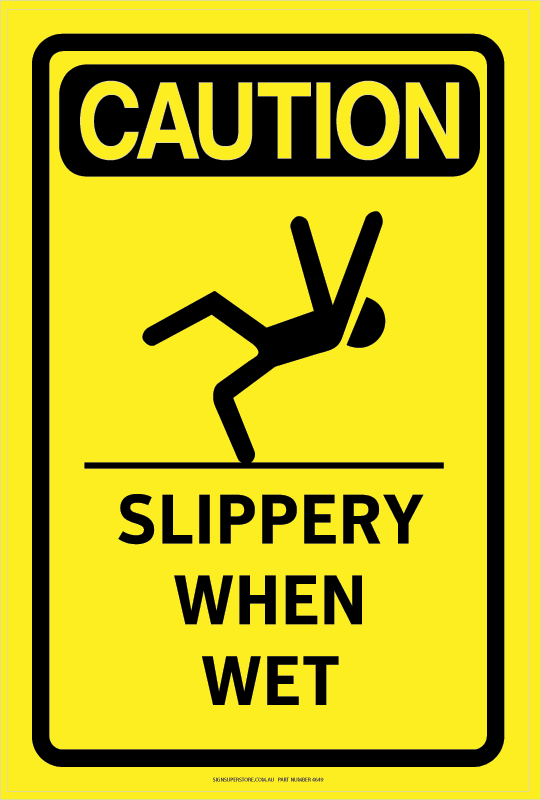
Health and Safety: As I mentioned it before, this was a big discovery of mine, more annoying when one is trying to organise an event, or when they tell you that electric appliances need to be ‘PAT tested’, but rather entertaining in the public space. For example, this sign. ‘Slippery when wet’, which you can find on the staircases of many train stations. I cannot imagine it in French ‘glissant en cas de pluie’ or in German ‘rutschig wenn nass’ hanging in a train station in continental Europe. For us that sign makes as much sense as saying ‘cold when snowy’ or ‘bright when sunny’.


Plug socket switches: Why you need a switch on plugs is beyond me... and at the beginning of my time in England many devices were left uncharged, as I forgot to turn switches on. Terrible. More importantly they have created a generation of OCD people, who have the compulsion of turning them off when nothing is plugged in (You know who you are!).

Separate water taps: Really? I mean still? Why? I love getting up in the morning and having to decide whether I want to freeze or burn my hands today. 

The food: I think when my (French) Mum left me in England, she was quite worried about what I would eat and even in the following months she needed regular updates on my eating habits, as I was not only living on my own for the first time and but also in ENGLAND, where the food, according to good old stereotypes was just dreadful. I had a few bizarre encounters with beans on toast, which I still don't like, as well as Marmite, cucumber sandwiches and breakfast sausages. But there are certain things which I will deeply miss very soon, like real tea, like cadbury and galaxy chocolate, a cheap pub meal, curly fries, coffee at every street corner…

British Humour: What is British humour? Judging from what most British people I know laugh about, it's dirty jokes, but maybe I just have the wrong kind of friends... However, even sarcasm, self deprecating humour also exists abroad, but I guess British people are simply the champions of it. Just next time somebody understands British humour, don't be surprised, it's not THAT hard to get.

Systems: I mean, I could complain about driving on the left and not using the metric system, but in the end it's just a different while still equally efficient system to ours. However, when it comes to height, I have little understanding for the usage of feet and inches, and even less for the usage of pounds and stones for weight... I mean... what ? Stones? It confuses everybody. Now for all those who aren't familiar with this :
1 Stone = 14 pounds
65 kg (probably the average weight of a woman) = 10 stone 3.3 lbs

 What I see when people talk about weight in stones


Anyway, I have nothing more to say. I will miss this country and its people dearly and who knows maybe my ‘Au revoir’ will become truthful sooner than I think!

27 Jun 2012

Crossing the Sea... a Youth in Action training course

I have just come back from a wonderful week at a Youth in Action training course On ‘Crossing the Sea- Euro-Med Dialogue’ and I just wanted to share my thoughts about this course with you.
It is so difficult to describe, yet there is so much to tell.

Participants came from the UK, Portugal, Slovakia, Palestine, Israel and Egypt. It was a rather random mix, with all sorts of languages being spoken when I arrived. The week was filled with team-building and trust exercises, reflections on what good communication is, opportunities to learn about each other’s culture and a lot of laughter! It was like living in a comfortable little bubble.

Together we also visited the Grange, a Camphill village, which is a community that takes care of adults with special needs by really including them in their daily activities. The Grange produces its own fruits and vegetables, they have different farm animals, a bakery, and residents also weave baskets, make pottery and different decorations in their wood workshop, which they sell locally and internationally through the Camphill network.

We then visited Bristol, and despite the rain, which was only appreciated by our Middle Eastern friends, we had some beautiful views of the city, with a strange mix of old buildings and its famous street art. We had the opportunity to pursue our own artistic streaks through a workshop with painter Jeroo Roy, who showed us her work and guided us through our own inspiration. We also helped organising ASHA’s open day, for which the group prepared typical food, dancing, crafts, sports, an interactive theatre play where the audience acted out a variety of Egyptian stories through the different civilisations and a Palestinian wedding as a grand finale.

  
Art Workshop*

One of the exercises -I know that I have never been blindfolded this many times in my life!*

The place where we stayed, the ASHA centre, is a little oasis of peace in the middle of the Forest of Dean. The smells of the rose garden, the taste of the fresh fruits and vegetables, the sounds of the stream that runs next to the property, the sensation of wet grass under your feet and the beauty of the people and the place I will never forget.

the ASHA Centre

The sun sets on the rose garden

A last night of dancing, clapping to Arabic rhythms, singing, sheesha smoking and laughing and it was already the end!

As I stepped out of Birmingham train station and stepped into the hustle and bustle of the city centre, I suddenly felt alone, lonely even, alone amongst all these people, after having spent a week in the middle of nowhere, it was quite odd. At ASHA, every person you meet makes eye contact, smiled, had a friendly word for you, or even a made-up song purely consisting of the repetition of your name. Here, I am alone, you have to look out not to bump into anyone, you are aware of the people, but you see them as obstacles.

As I unpack in my room, I can still hear the voices of the friends I made, the way they pronounce my name, the words they invented, their laughter... now I really feel alone.

Get back to real life? No. I'll first watch the pictures :)


Adrian, Zeiad, Ameed, Jad, Peter
Mark, Antonio, me, Tareq
Haythem, Elisabete, Moataz, Abed
Gina, Linda, Monica, Lucie, Ahmed
Lubka, Denisa
Mahmood, Nasr, Kawther, Gabriela, Alex, Areej
Alex

and Hayat is taking the picture :)*

*Pictures courtesy of ASHA


26 Jan 2012

Across the Hadrian's Wall


After last year's travels, final year has condemned me to become a sedentary working hermit, whose natural habitat is the library. Now, my feet were getting very itchy, so I decided I needed a change of scenery; I jumped on a train and off I was to Scotland!
A charming 5 hour journey later, I arrived in Edinburgh. The dark eerie buildings on the colourful evening sky (we are talking 3pm here) enchanted me the minute I got there. Edinburgh is beautiful from all its angles, but the absolute highlight is the view from Arthur's seat, a 822 ft extinct volcano in the middle of the city! There was loads to visit in the centre, such as the National Museum of Scotland with its curiosities, the Museum of Childhood, the Castle of course.

The view from Arthur's Seat
I also had the delight to see Tian Tian and Yang Guang, the two Giant Pandas who were new to Edinburgh, just like me. They have become such an attraction that we had to book a visiting slot online! What celebrities! The other highlight of Edinburgh Zoo was the penguin parade. A few years ago, the zoo keepers had accidentally left the door to the penguin enclosure open (in my opinion such inadvertence is not acceptable in a zoo!) and a few penguins had then decided to take a walk through the zoo before diligently returning to their enclosure. Today, the zoo keepers organise it, forming a sort of moving path with the visitors. The slightly clumsy humanoid walk of the penguins is just endearing!

Then, off I was to the lovely countryside. All you need is a half decent map, a small car for the small roads and a warm set of clothes! We just chose to wander off to random places, as in West Scotland, no matter where you go, you are almost certain to find beautiful scenery. That's my kind of place!
My personal recommendation is to take the east road of Loch Ness, which was much more exciting than the west road, which runs along the lake. We suddenly ended up in a winter wonderland, with a snowy island in the middle of another loch. Then down to Foyers. (which was originally chosen as destination for lunch for its resemblance to my name, as my original plan was to claim the place!) A huge waterfall can be admired there and less tourists come here, but then again, it was January, so there weren't many people anywhere!


The journey ended on a great culinary note, with the best fish and chips in Britain in a little harbour town in Fife called Anstruther. It was a perfect goodbye, although it's probably just an 'au revoir!'.


4 Aug 2011

The Good, The Bad and The Funny: Jordan


Here are just a few general remarks on life in Jordan :)

Men. There are good days and there are bad days. On a good day, a Facebook message saying things like this makes me laugh :

I love all the stars in the sky, but they are nothing compared to the ones in your eyes!, ...... Only I need to know are you still single???.. ???..... i am looking for making a relationship..... i hope you like me ……...i want to be your real friend if you do not mind ....i live at Amman .... i see your photos... if you do not mind let us know each other first at internet ... ...i have master degree with Electronic Commerce ... …I will tell you more about me …. …I like your photo very much …. I will do anything for making you happy, ...if you need any help,, I am ready to give you my hand…… you are more beautiful than moon, i can not forget your eyes... There are 20 angels in the world,…..10 are playing,…..9 are sleeping,…..1 is reading this message…. Please add me and reply me soon ..... if you are not single please accept my apology .... god bless you .... thank.. “ (Wadaa Salim, 13th July)

So do random love declaration, grammatically incorrect remarks. However, the constant starring, the kissing noises, the 'tstststs', the 'are you married?' are exhausting, especially on a bad day. That is one thing I haven't got used to in the four months I have been here, it annoys me just as much as on the first day. There are a few ways around some of the things, but they are pretty inefficient. You can dress modestly, but unless you're hiding under a ninja outfit, they won't leave you in peace. What I find amusing is to tell taxi drivers various stories when they question me. The one I use most is the one where I am married to a Jordanian from Irbid and have a son called Mohammed. If you wonder why I don't just ignore their questions, well, there are two reasons. First, I feel it's impolite (even if I know it is ok not to answer, I just can't help to feel rude) and also, taxi drivers are the only ones who speak in Arabic to me.

One could probably write a book on taxis in Amman. In summer, a silent 'masha'Allah' crosses your lips when a Taxi with closed windows stops: it has air conditioning! The others have a different way of “creating” air conditioning: they drive as fast as they can while leaving all windows open. The only problem: the increased traffic in summer, thanks to all the khalijis (people from the Gulf) who are enjoying the “cool” Ammani climate! What I love about taking taxis, is the way one gives directions. No one knows street names. In fact I have no clue about the name of the street I have lived on for three months. Not that I ever needed it. I was once asked at border control, as I was re-entering Jordan, what my address was. I had no idea - I just told them my neighbourhood- Al-Yasmeen. To get to a certain place in Amman, it is necessary to indicate a landmark near the place you want to go, unless you're lucky enough to be going to an obvious place, such as city mall or a specific hotel. In the vicinity of that landmark, you need to indicate to the driver where it is you want to go. The great thing about that is the fluency you acquire in taxi arabic. I can convince a taxi driver to go on a one way street, explaining that there is no traffic and that it is only a short bit, but I can only buy about 6 different fruits and vegetables without pointing.

Another means of transportation I enjoy is the bus. I have taken the one to Jerash many times and it has helped me to become more patient. The way it works is that the bus leaves when it's full, knowing that there are about 20 seats. Sometimes you're lucky, sometimes you're not. The unpredictability can be mish kwayyis. (not good)

The recent uprisings in the Arab world have confused people back home even more I feel. Nothing major happened in Jordan. At the various demonstrations that occurred during my time here, quite a number of protesters were beaten up, but nothing severely threatened the regime. I usually avoided risky areas such as downtown after friday prayer, so I haven't seen much. Just police getting ready on Friday morning in the balad, various protests in front of the Prime Ministry at fourth circle and protests in front of the Syrian embassy, back in May and June, when people cared.

Before I got to Jordan, I was so excited about the food! I figured I would put on a stone ( I rather lost a few kilos – due to a various digestion issues) . Hummus, falafel, tabbouleh and so on being the standard dishes in most places, become less exciting and are only convincing when they are really good. I know I will miss them at some point, probably when I will be facing toad in a hole, smothered chicken and fish and chips on a menu. The traditional Jordanian dish is Mansaf.(Wiki page: Mansaf ). The best Mansaf I've eaten was the one the women in the camp prepared. Jabri's is nothing compared to that! My favourite drink in the Middle East is Lemon and Mint. It is simply the best. It is refreshing, helps you digest and goes with anything. If, however, you are a fan of Coca-Cola, you will have difficult moments in Jordan, where Pepsi is the leader on the market. It was always a moment of exhilaration whenever a shop sold real coke. And although some might deny it: Pepsi is no Coke! (even when you are really REALLY thirsty!)

Getting dressed in Jordan was one of the most annoying things. It was hot enough to walk around in a swimsuit and yet, better cover your elbows and knees. I have never dressed that much for other people as I have in Jordan. Although you get used to knowing what is acceptable and what is not in certain neighbourhoods of Amman, I often checked with a friend whether I was dressed appropriately enough. I am looking forward to the UK, where you can wear whatever you want, because there will always be someone weirder.

One of the most frustrating things in Jordan was service. Most expats complain about it. In shops or restaurants, there is either one guy, who is really slow and totally overwhelmed or there are five guys and they are totally inefficient, because they are either all helping you or none is helping you. Waiters in restaurants generally never deserve tip and client satisfaction is a notion that is lacked in many places. Of course, in some restaurants and cafés people were friendly and effective, but they were the exception.

My favourite time of the day in Jordan is sunset, especially if you are sitting at Old View Café in Jebel Amman. The city is slowly infused in a myriad of orange, yellow and pink tones. Kids are flying kites. Trained pigeons are flying in circles and the call for prayer starts all over the city. It's divine.


My favourite experience in Jordan was meeting the women at the Gaza refugee camp. I went there several times to teach English in a gym. Sometimes they were 20, sometimes 7, but they were always the most genuine and nicest people I have met in Jordan. I didn't feel like a stranger in their group as we talked about life, food, sports or clothes. I found the female solidarity I was looking for in the Middle East. It broke my heart when I had to say goodbye and if anything will make me come back to Jordan, it is what I found in the camp.

19 Jul 2011

My Palestinian experience

I have two Palestinian stories to tell...

Palestinians in Jordan

When you take the bus from the North Station in Amman to Jerash and you don't stop at the ruins, like all the other tourists, but you stay on the bus, you will get to where I am going every week this month: Ghaza Camp or Jerash Camp.

This is what UNRWA (United Nations Relief and Works Agency for Palestine Refugees in the Near East) tells you about the camp: 

Jerash refugee camp

Jerash camp was set up as an "emergency" camp in 1968 for 11,500 Palestine refugees and displaced persons who left the Gaza Strip as a result of the 1967 Arab-Israeli war. It is known locally as Gaza camp.
The camp covers an area of 0.75 square kilometres and is situated 5km from the famous Roman ruins of Jerash. After 1967 UNRWA quickly set up facilities for food aid, sanitation, health services and education.
In order to withstand the harsh winters, the original 1,500 tents were replaced with prefabricated shelters.
Between 1968 and 1971, 2,000 shelters were built with support from emergency donations. Over the years, many of the camp’s inhabitants have replaced the prefabs with more durable concrete shelters. Many roofs are still made of corrugated zinc and asbestos sheets, which can cause diseases such as cancer.


Statistics

  • More than 24,000 registered refugees
  • One women’s programme centre
  • Four schools in two double-shift buildings
  • One food distribution centre
  • One health centre
  • One community-based rehabilitation centre
  • One camp development office
Major problems
  • Poverty
  • Overcrowded
  • High unemployment
  • Around 3 in 4 shelters are not suitable for accommodation because of structural problems.

Fact sheets may speak the truth but are far from drawing the full picture. Imagine walking in extreme heat up the hill between small concrete huts. Some kids run past you, screaming 'hello' or the occasional 'I love you'. The smell of the open sewage system makes you feel slightly dizzy. In the middle of the street, a little canal is supposed to lead all the sewage somewhere, but the sewage doesn't flow very often. Water is scarce. 

A lot of people of Jordan are not (or do not want to be) aware of the situation. They know of the existence of camps but ignore where they are and what is going on there. In Gaza camp, things are very difficult, because the vast majority of refugees come from Gaza or areas around Beersheba and have flown during the Arab Israeli war of 1967. This means that they are not recognised as being citizens of former Jordan, when it still included the West Bank and thus they are not entitled to the Jordanian citizenship, which entails a lot of other problems: There are only a few professions that are allowed to them, they cannot vote and they have to pay university fees of foreigners, which are much higher than the national ones.

It seems to me sometimes that Jordanians defend their Palestinian brothers when it's to their advantage, but at other times it is easy to ignore their plight. I have talked to quite a few who don't seem to care so much about the Palestinians' hardship and it's not uncommon to hear Jordanian voices being raised on how invasive the Palestinians have become. This is of course ridiculous considering the fact that the vast majority of successful business men and millionaires in Jordan are in fact of Palestinian descent. The country wouldn't have got as far as it has without the Palestinians.

Luckily there are some people who do care. Great initiatives have been taking place. For example The Gaza Camp Summer Camp and the Women's catering service, whose food has been judged by many (including me) as the best food they have eaten in Jordan.

Palestinians in Palestine

I ventured to cross the Jordanian-Israeli border a second time and it was a lot more hassle than the first time. Apparently I was considered as “suspicious”, that's why we had to wait half an eternity, while they had our passports until a very grumpy woman called me in. Waiting in the daunting corridor, doors being slammed by by-passing security in a horrible neon light was pretty grim. After a while the grumpy woman called me in, asked me all sorts of weird questions about what I was doing in Amman, whether I was part of a Human Rights group and what I thought of the Israeli-Palestinian conflict. She screened my bag thoroughly, taking out EVERY clothes item I had and going through each of my photos on my camera. She looked at my diary, luckily I write it in German- so she couldn't understand it.

The whole process can be summarized in the rather pertinent German term 'Schikane', which means as much as bullying and harassment. When I look at how we, as European and American citizens, are treated, I cannot imagine how difficult the crossing can be for the Palestinians who try to go to Palestine every month or every week, to see their families or to continue to do business. A lot of stories exist on what sick procedures the Israelis come up with, whether it is to make you sit in one of their cells, waiting for 4 or 5 hours or to alternatively strip you down to your underwear and make you wait. They would not dare doing that to a Westerner and if a Palestinian would speak up, they would just never let him in again. When in Israel, I had to think of a book I came across some years back. It is a cartoon novel, about the Holocaust, it is called Maus. It is a very good reading. Its specificity lies in the fact that it depicts the Nazis as cats and the Jews as mice. Now I can't help but having flashbacks of Europe between 1933 and 1945. Have the mice become cats? In Hebron, there is a graffiti left by Israelis saying “Gas the Arabs“. When I saw this, I felt like throwing up. What kind of person wants such history to repeat itself? How can ANYONE, anyone, who has probably lost family members in the gas chambers of Auschwitz, want this to happen to another human being? How? I can't see how you can be human and say such a thing. When I went to the Auschwitz-Birkenau Camp, there were many Israelis. Isn't one of the teachings of such a visit: “Never Again”?


A shopkeeper in Hebron repairing the protections.

On my second day in Palestine, I visited Hebron. We arrived on a busy street, that looked a bit like Madaba in Jordan. Nothing special, a few shops, cars, people, life... A few hundred meters down the street however, things started to look differently. We reached the old city of Hebron. The streets were very picturesque, some shops were closed. It being a Friday, we didn't suspect anything. Above the street, there were nets, metal grids and tarpaulins. On top of these, there were bricks, plastic bags, old vegetables and all sort of rubbish. Turns out the Israeli settlers living upstairs were throwing these things onto the shopping streets.

A Palestinian tour guide picked us up as we were looking at the streets... we didn't see any other foreigners apart from the settlers in Hebron. He lives off showing around the few tourists that come to Heron, and he has another job: As he lives in the occupied part of the city, the H2 part, he is able to cross the check-points. In the morning and in the afternoon, he accompanies the children from the H1 part to the school and back, as it lies in the H2 part. In the past, settlers were throwing rotten and old vegetables as well as eggs at the children who were going to school. Now, the community makes sure that there is always someone protecting the children.

We crossed the check points and as Westerners, we were allowed to enter the synagogue and see the tombs of Abraham, Sarah, Isaac, Rebecca, Jacob and Leah. These tombs are the 'reason' why the Israelis decided to occupy this part of Palestine. Even in the synagogue there are soldiers with what I would qualify as big guns. I have never entered a church, where anyone was holding a weapon. If soldiers are necessary inside a holy place, then you probably did something wrong! In the H2 part, there are a few settlements, which hold in total about 400 settlers in the town itself. Outside the town, there are 200 more settlers. To ensure their security, 2000 – yes, two thousand- soldiers are stationed in Hebron. There is no sane way of understanding this.

In the H2 part, the streets are empty. Not because it is so hot in July, but because only the settlers, the soldiers, the other foreigners and the few Palestinians, who live in the H2 part, are allowed to walk there. The Palestinians were forced to leave during the Second Intifada (2000-2005) and the shops were forced to close. The welded doors do not lie.

But the question that bugged me most and that you might ask yourself as well: Who are these settlers?

Do they work? No. They get paid by the Israeli government. Where are they from? According to our guide mainly from New York and Washington. Why do they come? They get paid a lot of money, they have near to no expenses and all they do is pray and throw things at Palestinians. The more they hassle the Arabs, the happier the Israeli government it seems. What kind of people they are? I have no idea. I cannot fathom their minds... Of the few settlers we saw, most were young parents. Most settlers stay for a few years and save money.

 The Checkpoint


Empty streets? Well, most Palestinians aren't allowed to walk here.

The burnt down bus station 

The Western Wall: Did anyone write "Free Palestine" on one of these?

Our guide said at the end of our visit: “I don't have a problem with the Israelis or the Jews, I just don't like settlers.” 

17 Jun 2011

'Smile! You're in Beirut, not in Abidjan!'


My weekend tripping in the Middle East had to include Beirut of course. I was there for work twice, but had some time to get the flair of the city as well as Jounieh, where I stayed during my second job assignment in Lebanon.

Lebanon is amazing. Coming from Amman, it appeared to be really liberal and very Western. Also, the fact that Beirut lies on the Mediterranean sea just makes this city a delightful place. I particularly liked the welcome greeting from a tea-selling gentleman: “Smile! You're in Beirut, not in Abidjan!” (At the time, post-civil war Ivory Coast was making the headlines.)


Sunset on the road to Jbeil


We walked from Hamra, where we were staying, to Downtown, along the beautiful streets. A few destroyed buildings, vestiges from the civil war, had caught our eye on the way from the airport, but what struck us in the city itself was the presence of so much military: they were everywhere! (just like cedar trees!) Also we couldn't access part of the pedestrian area because demonstrations were announced. Afterwards an AUB professor explained to me that they tend to close up that part even if only ten people end up demonstrating.

Beirut is beautiful. One cannot deny it. The first time I was not sure if I would abandon my Amman for it. Somehow Amman had grown on me, in the one month I had lived there, but now, with a little more perspective, I start considering Beirut as a possible future home!

For now it is an opportunity to to get away from a quite conservative society and show a little bit of skin! My first thought when I saw a young Lebanese woman wearing a tank top was “Girl, you're practically naked!” Also to see people kissing on the streets made me feel slightly uncomfortable at first. What has Jordan done to me? :)

Other places, that I can really recommend are Jbeil (or Byblos) and the Jeita Grotto. Jbeil is a very cute sea port, where you can visit the castle ruins, which look amazing, especially at sunset. There are plenty of bars and restaurants along the Souq and the atmosphere is generally relaxed. In Jeita, we visited a stalactite cave, which was really impressive, even before we entered the actual cave. Indeed, Jeita Grotto is located in the mountains, not too far from the coast though, and the hills are covered in Green! It looks like paradise, because two and a half months in the desert make you miss green nature: pastures, fields, the grass chewing cows of Normandy, a little stream and... I should stop, because even if I have a little home sickness, my appreciation for the Middle East hasn't waned !


Greeeeeeeeeeeeeeeeeeeeeeeeeen treeeeeeeeeeeeeees


In Lebanon, we stayed in a Christian area, which is distinctive by certain religious pictures (including photos of the pope), frequent statues of Holy Mary, no muezzin who wakes you up in the morning and also skin: hot pants and bare shoulders! It really feels like Europe and the easiness of life felt good.

When I boarded the plane back to Amman, I could already feel the melancholy. I don't know when I will return to Lebanon, but I know I will come back and I dearly hope that it will be soon!

11 Jun 2011

Petra, Aqaba and the Dead Sea


Right now I'm writing from the terrace at the well known Books@Cafe in Amman, where some jazzy tunes accompany the beautiful view onto one of Amman's hills. It is nearly mid-June and the days are now becoming quite hot, people stay up late and every morning I wake up to a sunny day. I want to use this rather relaxed Saturday to portray my recent escapades around the country.

There is one thing, a visitor of the Hashemite Kingdom of Jordan cannot miss out on. Petra. In fact, from the moment I knew I was coming to live here, people started telling me “You have to go to Petra!“ It's the biggest thing in the country and the developments of the historical site, financed to a large extend by USAID, have created a real hype. OF COURSE I was going to go there. After the 20th “Are you going to visit Petra“ I nearly wanted to shoot myself. I mean, would you ask someone who is planning on living in France, whether he or she will see the Eiffel Tower? Or would you ask: “Are you going to eat Tapas in Spain?”. Anyway, when I got here, the question became: “Have you been to Petra?“. After all this pressure, I am so glad that I can say: “I have been to Petra“ and I can also expose the banalities that every visitor is able to produce, qualifying the site of beautiful, mind-blowing, huge, hot, amazing... Indeed it is an incredible place, but allow me just to say how fed up I am with hearing people talk about it. This is why I am just going to do a few remarks on the place, and for more information, well GO THERE!


  Petra


A Frenchman we met there described Petra to be beyond everything: beyond time, beyond civilisation, beyond imagination... Indeed. It's difficult to believe that this used to be a flourishing city, while you are roasting on the way up to the superb views in the mountains. It is truly amazing and in my opinion, it's worth going for three days and just enjoy hiking around the place, because during the weekend we spent there, we were only able to see the main parts of it. Also, I might be interested in history, but I have a threshold when it comes to the intake of information. Thus, the thing I enjoyed most was being outside, with magnificent weather... 30° degrees sunshine (a bit cooler would have been even better). Hiking in such a beautiful place is incredible and my favourite spot of it all is what they call “The view of the end of the world“: beyond the Monastery, there is a spot in the mountains where you see the beginning of the desert and it just appears that if you continue walking, beyond the horizon you will fall of the earth. It is just magnificent.

A week later, I had the opportunity to see a bit more of south Jordan, especially the major coast city of the country: Aqaba. Although it is a beach resort, society there remains quite conservative because of its close ties with Saudi Arabia, only a dozen miles away. At the Red Sea, there is not much to do but lie at the beach, go snorkelling, scuba diving and enjoy other leisure activities. On top of that, the city is in a 'Special Economic Zone' so that especially alcohol and cigarettes are particularly cheap, which is quite an incentive to a lot of people every year!

Sunset on the Dead Sea

Jordan is also a great place for beautiful panoramas, especially the breathtaking canyons leading to the Dead Sea, which are called Wadis. However, getting around can become a pain when you miss a road and the lack of signs does not help in that matter! It can easily mean a 60km detour but for us it was an opportunity to accidentally drive past incredible views, that you don't find in any guide. Then in the vicinity of the Dead Sea, there is Mount Nebo where Moses is said to have seen the Promised Land before dying without ever reaching it. The view is beautiful there and at night you can see the lights of Amman in the East and the lights of Jerusalem in the West. On our bible-themed day, we also visited the Baptism Site, where John the Baptist is said to have baptised Jesus. The most impressive aspect of the site, in my opinion, is that the size of the Jordan river has been quite reduced, mostly because of Israeli irrigation policies upstream. This means that at the Baptism site, you are only standing ten feet away from Palestine. You can see some of the churches of Jericho! The distance in physical terms is ludicrous compared to the distance in constructive terms. However, the essential problem with the decreasing flow of the Jordan River is that the Dead Sea is slowly... well, dying. At the shore you can clearly see from the salt residues, where the water level used to be. A project of building a canal connecting the Red and the Dead Sea exists and it would reverse the shrinking of the latter. However, it also bears the name of Peace Canal, because regional cooperation is essential in its construction, but in the current climate, the project seems far from being realisable.

On a much lighter note, the Dead Sea is a perfect escape on weekends. From Amman, it takes about an hour to go to the lowest point on earth and then you can spend a day at the pool in the various hotels or beach complexes for about 20-40 JOD (20-40€) and spending a day in a bikini is a great bubble of oxygen!  

Kate and me at the pool bar...

9 May 2011

Jerusalem, Bethlehem and a lot of buses


Last weekend I had the pleasure (and the courage!) to undertake a weekend trip to Jerusalem. I left my office in Amman (thanks to the generosity of my boss) at 2pm. The taxi to Tabarbour during Ammani rush hour was a pain, but then I had to wait another 45 minutes for the 'serveece' (shared taxi) to fill up. We were finally on the road to Jssr Almalak Alhussein (King Hussein Bridge or how it is called on the other side: Allenby Bridge). That was just the beginning... Then a first passport control on the Jordanian side, a very long and slow ride over the rather unspectacular King Hussein Bridge. Then a first, a second, a third and a fourth passport control, two luggage scanning and the according queues. Not to forget the very unfriendly “Why?!“ when I asked my passport not to be stamped.

There I was! Just a very expensive shared taxi ride away from Jerusalem. First sign to show me that we weren't in Jordan any more: “Please, put your seatbelts on!“ In Jerusalem, I walked along the dark streets, and despite my initial apprehension I felt rather safe. While I was waiting for my friends in a coffee shop, a very illuminated New Zealander interrupted me in my chilled latte sipping to talk to me about God, but Jerusalem was the last place on earth I would let myself be told that Christianity was the only way to heaven! Anyway, I was quite happy when my friends called me to let me know that they had also made it to Al-Quds, and it was time to explore the city, at least the bars and restaurants. Unluckily a thunderstorm and hail welcomed us.

On our first day we decided to wander the streets of the Old City, to see all the different quarters. It was a wonderful feeling to be walking again. Anyone who has been to Amman will have felt this need for walking, as in the Jordanian capital, it is not really a possibility: there are no pavements, the streets are broad so that you can't walk in the shadow of a building and anyway taxis are cheap. The many shops and small streets of the Old City made us feel like we were roaming around a post card. Our first thought was 'this is how I imagined the Middle East' and not the traffic, the dirt, the modern buildings we see every day! We went of course to see the wailing wall and the spirituality there was incredible.


However, unlike many visitors I did not succumb to the famous Jerusalem syndrome: no spiritual awakening. I thought that here out of all places I could have felt something, but surprisingly other places in the World have made me feel much more near to something divine. Then again a Jewish guy in our Hostel said that he had to look into the mirror every morning and tell himself that he was Jewish, as he saw so many people  of different faiths, who believed so strongly and whose experiences in Jerusalem were so incredible.

On day two we undertook a trip to Bethlehem in the West Bank and against every UN security statement we went by bus, which in these times of increasing tensions are the main target of extremists. Getting there was not a problem and I was amazed by Bethlehem. It is not very big, but it has a very nice city centre and after a delicious meal at Al-Hafteem we visited the Nativity Church. It is odd to see the context of a story you know since you are little. Jesus' birth is one of the first stories I ever heard and seeing the cave where it is supposed to have taken place was just unreal. It was like stepping into my little illustrated bible.
Then we saw another attraction of Bethlehem... the Wall. Being German, Walls bring up deep feelings, and seeing that wall just made me feel like vomiting. The Israeli soldiers were probably pointing their sniper at us from the watchtower. To get back to Jerusalem, we had to go through a checkpoint, that was described to us as still human, but it was so eerie. The worst was that the Palestinians were treated much more severely than us, the guard barely looked at my passport whereas the Palestinians were checked in detail and had to leave their finger prints.

In the evening we went to a bar in the New City of Jerusalem and suddenly it felt like being in another world. A world that looked a lot like ours. This bar could have been anywhere in Europe. How could all this make sense. The horror stories you hear about how Palestinians are treated and the bit you see of it versus the normalcy of life in new Jerusalem. Where are the bad guys?

The next day, we crossed part of the country and on our bus journeys we passed by so many IDFs: they were just teenagers with guns. One of them stuck her tongue out at my friend who works at UNRWA. Wow.

The journey back was incredibly long and difficult, accompanied by a little nervous breakdown of mine because of the stubbornness of the border police, the angry Italians and the enormous group of Koreans that somehow had priority.

It felt good to be back in Jordan.